
Welcome!
The junior research group for Eco-Evolutionary Modelling, led by Dr. Korinna Allhoff, was founded in April 2022. Our research projects are diverse and rooted in various sub-disciplines of ecology. All of them have the common goal to understand how complex ecosystems are structured and how this structure affects their functioning and stability. We are particularly interested in questions related to the eco-evolutionary emergence of complex interaction networks, as well as their long-term responses to disturbances and changing environmental conditions. We address our research questions from a theoretical perspective using a mix of tools, including individual-based modelling, dynamical systems theory and adaptive dynamics.
If you are interested in joining the team or if you have questions concerning the courses that we teach then please don't hesitate to get in touch. We are always happy to chat! :-)
Links
We are part of Hohenheim's Computational Science Hub, the Center for Biodiversity and Integrative Taxonomy (KomBioTa) and the FLINT consortium. Korinna is co-founder and organiser of the LunchBox Models seminar series.
Group gallery Team members
Preprints & Publications Teaching
Contact

Dr. Korinna T. Allhoff
Institut für Biologie
FG Eco-Evo Modelling (190m)
Garbenstraße 30
D-70599 Stuttgart
Office: Bio II, 1.OG, Zi. 195/196
Tel.: +49 (0)711 459 24239
E-Mail
This is us...
 |
| 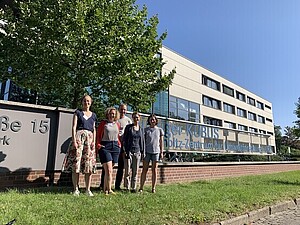 |
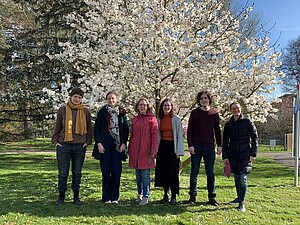
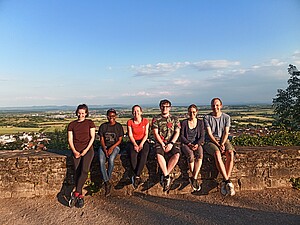
...in March 2023, after taking a walk around our beautiful Campus, in the botanical garden in Hohenheim. From left to right: Elisabeth Lang, Avril Weinbach, Korinna Allhoff, Franziska Koch, Sebastian Krüger and Malina Palmer. | ...in June 2023, after taking a well-deserved break from maths and coding in the "Waldseilgarten" in Herrenberg. From left to right: Franziska Koch, Deborah Doe, Korinna Allhoff, Knut Reindl, Malina Palmer and Felix Jäger. | ... in September 2023, after organising a session about feedback loops at the European Conference on Ecological Modelling in Leipzig. From left to right: Avril Weinbach, Korinna Allhoff, Felix Jäger, Malina Palmer and Franziska Koch. |
 |
| 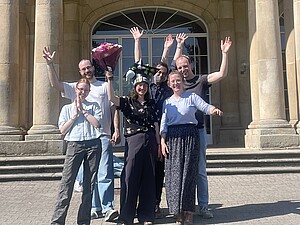 | |
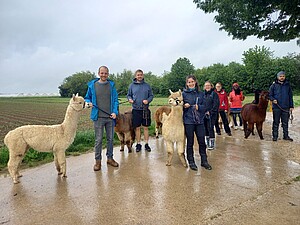
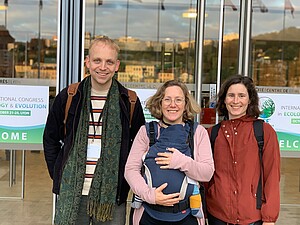
... in May 2024, very much enjoying a rainy Alpaca trekking tour in Nürtingen. From left to right: Felix Jäger, Ádám Németh, Franziska Koch, Korinna Allhoff, Mira Baer, Deborah Doe and Robin Seidt. | ... in October 2024, right before presenting our research at the SFE2 meeting in Lyon. From left to right: Felix Jäger, Korinna Allhoff (with baby) and Franziska Koch. | ... in April 2025, celebrating the freshly awarded Dr. Franziska Koch. From left to right: Mira Baer, Rémi Legrand, Dr. Franziska Koch, Dimitrios Nakos, Korinna Allhoff and Felix Jäger.
|
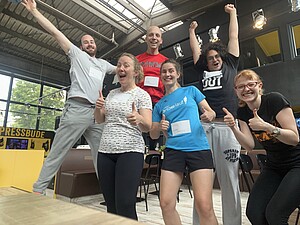 | 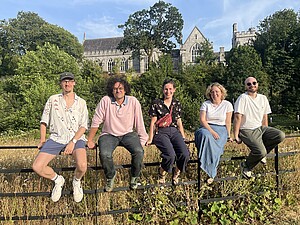 | 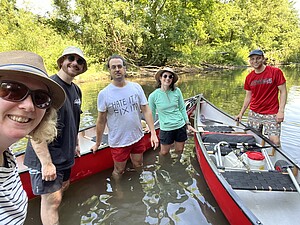 | |
... in July 2025, having fun in the "Sprungbude" in Bad Canstadt. From left to right: Rémi Legrand, Korinna Allhoff, Felix Jäger, Franziska Koch, Dimitrios Nakos and Mira Baer. | ... in July 2026, enjoying the conference vibes at the MMEE in Cork, Ireland. From left to right: Simon Leoz, Dimitrios Nakos, Franziska Koch, Korinna Allhoff and Rémi Legrand. | ... in August 2026, going on a canoe trip on the river Enz. From left to right: Korinna Allhoff, Rémi Legrand, Dimitrios Nakos, Franziska Koch and Felix Jäger. |
Active group members (June 2026)
| Name | Title | Role | Contact / more information |
|---|---|---|---|
| Allhoff, Korinna Theresa | Dr. rer. nat. | group leader | E-mail / Google Scholar / ORCID / ResearchGate / Mastodon |
| Jäger, Felix | M.Sc. | doctoral researcher | E-mail / Google Scholar / ORCID / Homepage |
| Nakos, Dimitrios | M.Sc. | doctoral researcher | E-mail / Mastodon |
| Legrand, Rémi | M.Sc. | doctoral researcher | E-mail / ORCID |
| Leoz, Simon | M.Sc. | doctoral researcher, guest student from IGB Berlin |
Alumni / completed theses
| Name | Title | Year | Contact / more information |
|---|---|---|---|
| Seidt, Robin | B.Sc. | 2026 | |
| Koch, Franziska | PhD | 2025 | E-mail / Google Scholar / ORCID / ResearchGate |
| Doe, Deborah | M.Sc. | 2025 | |
| Németh, Ádám | B.Sc. | 2024 | |
| Baer, Mira | B.Sc. | 2024 | ORCID |
| Neumann, Jule | M.Sc. | 2024 | |
| Reindl, Knut | B.Sc. | 2023 | |
| Weinbach, Avril | Postdoc | 2022-2023 | Google Scholar / ORCID / ResearchGate |
| Lang, Elisabeth | M.Sc. | 2023 | |
| Krüger, Lorenz Sebastian | M.Sc. | 2023 | |
| Palmer, Malina | M.Sc. | 2022 | |
| Weyerer, Franz | M.Sc. | 2022 |
Preprints
- Jäger, F., Guill, C., Loeuille, N., Yacine, Y., Allhoff, K. T. (2026) Eco-evolutionary dynamics create extinction avalanches in mutualistic-antagonistic networks. BioRxiv. doi:
https://doi.org/10.64898/2026.09.21.753184 - Legrand-Duchesne, R., Koch, F., Ofosu-Bamfo, B., & Allhoff, K. T. (2026) Stabilising effect of modularity in antagonistic networks depends on intra-guild interactions. BioRxiv.
https://doi.org/10.64898/2026.07.17.739155 - Jäger, F., Loeuille, N., Yacine, Y., Allhoff, K. T. (2026). Between Friends and Foes: Evolutionary Diversification in Mutualistic-Antagonistic Networks. BioRxiv.
https://doi.org/10.64898/2026.02.16.712075 - Leoz, S., Lutscher, F., Allhoff, K. T., Govaert, L. (2026). Eco-evolutionary dynamics in competitive systems: Rescue or murder? BioRxiv.
https://doi.org/10.64898/2026.01.14.699340 - Schurr, F. M., Jäger, F., ... Allhoff, K. T. (2025) Fitness landscapes of biotic interactions shape the ecological and evolutionary dynamics of biodiversity. EcoEvoRxiv.
https://ecoevorxiv.org/repository/view/11164/
Publications
- Alberti, M., Allhoff, K.T., Barbour, M.A., Govaert, L., Malesis-Dahm, A. N., Matthews, B., Palmer, M., Pantel, J. (2026). Emergent properties of urban landscapes shape urban eco-evolutionary dynamics. Landsc Ecol 41, 173.
https://doi.org/10.1007/s10980-026-02450-8 - Baer, M., Allhoff, K. T:, Barnes, K. A. Koch, F. (2026). Forecasting bryozoan assemblage dynamics under simulated climate change. Ecological Modelling,
https://doi.org/10.1016/j.ecolmodel.2026.111576 - Koch, F., Neutel, A. M., Barnes, D. K., Allhoff, K. T. (2026). Many weak and few strong links: the importance of link strength distributions for stabilising patterns in competitive networks. Theoretical Ecology, 19(1), 1.
https://doi.org/10.1007/s12080-025-00626-7 - Jäger, F., Schurr, F. M., & Allhoff, K. T. (2025). From friend to foe and back: coevolutionary transitions in the mutualism–antagonism continuum. Proceedings B, 292(2051), 20242326.
https://doi.org/10.1098/rspb.2024.2326
Saravia, L.A., Allhoff, K.T., Bond-Lamberty, B. and Suweis, S. (2025), Modelling Amazon fire regimes under climate change scenarios. Oikos e10764.
doi.org/10.1111/oik.10764
- Weyerer, F., Weinbach, A., Zarfl, C., & Allhoff, K. T. (2023). Eco-evolutionary dynamics in two-species mutualistic systems: One-sided population decline triggers joint interaction disinvestment. Evolutionary Ecology.
https://doi.org/10.1007/s10682-023-10264-2
Koch, F., Neutel, A. M., Barnes, D. K., Tielbӧrger, K., Zarfl, C., & Allhoff, K. T. (2023). Competitive hierarchies in bryozoan assemblages mitigate network instability by keeping short and long feedback loops weak. Communications Biology, 6(1), 690.
https://doi.org/10.1038/s42003-023-05060-1
Koch, F., Tietjen, B., Tielbörger, K., & Allhoff, K. T. (2023). Livestock management promotes bush encroachment in savanna systems by altering plant–herbivore feedback. Oikos, 2023(3), e09462.
https://doi.org/10.1111/oik.09462
Older publications by the individual group members can be found on their online profiles (see above).
Teaching
We teach two courses, as outlined below. Both courses can be taken as part of the AI & Data Science Certificate Hohenheim (AIDAHO).
1) Computational Ecology: Modelling Systems Across Scales
This course is an introduction to agent-based modelling, primarily designed for BSc students, but also open for MSc students. It takes place during the winter semester. The main goal is to learn how to use computer simulations as virtual laboratories or virtual field stations. More precisely, participants practise (a) how to translate ecological questions into agent-based models, (b) how to implement and analyse these models using NetLogo, and (c) how to finally place their simulation results in the context of current literature. Based on these three skills, all participants carry out an independent modelling project at the end of the course. Students with very little (or even no) experience in modeling or programming are explicitly welcome. All relevant techniques and skills will be explained when needed so that no special prior knowledge is required.
2) Theoretical Ecology: From Chaos to Coexistence
This course is an introduction to dynamical systems theory, designed for MSc students. It takes place during the summer semester. During each session, we start with an ecological question, translate this question into a mathematical model and then investigate this model using a combination of analytical tools and computer simulations. Amongst other topics, we discuss early warning signals for tipping points, deterministic chaos, the paradox of enrichment, the competitive exclusion principle, adaptive dynamics, eco-evolutionary feedback and random matrix theory. We start with relatively simple models describing the dynamics of single populations, such as exponential or logistic growth. In a second step, we then move on to models of pairwise species interactions, such as Lotka-Volterra predation or competition. Finally, we also investigate more complex systems, such as interaction networks or systems with trait evolution. Each model is analyzed in an interactive manner, using jupyter notebooks, with lots of opportunities for practical hands-on experiences. Previous participation in the summer course can be an advantage, but is not a compulsory requirement.